LinkedIn Ads for Canadian B2B: When Paying $12 Per Click Actually Makes Sense
- Mauricio Martinez
Your Google Ads CPC runs $3-$8 for B2B keywords in Canada. Facebook delivers $1-$3 per click. LinkedIn shows $5-$12. Your instinct is to close the tab. That costs you customers.
LinkedIn commands 41% of B2B ad budgets globally, up from 39% in 2024. Canadian B2B companies pay premium because LinkedIn leads convert at 2-3x the rate of Facebook or Google. Average LinkedIn ROAS hit 121% in 2026, meaning $2.21 back for every dollar spent. That makes LinkedIn the only major ad platform still delivering positive aggregate ROAS for B2B in 2026.
The question isn’t whether LinkedIn costs more. It does. The question is whether those higher costs deliver better outcomes when you measure what actually matters: qualified leads that turn into closed customers, not clicks that fill your CRM with junk.
LinkedIn Advertising Costs at a Glance
| Metric | Google Ads | Facebook Ads | |
|---|---|---|---|
| Average CPC | $5-$12 | $3-$8 | $1-$3 |
| Average CPM | $30-$60 | $15-$25 | $7-$15 |
| Avg Conversion Rate | 2.5-3.5% | 2-4% | 1-2% |
| Lead Quality Score | 8.5/10 | 7/10 | 5/10 |
| B2B ROAS 2026 | 121% | 85-110% | 45-70% |
Source: Dreamdata 2026 LinkedIn Benchmarks, Stackmatix Cost Analysis
Why LinkedIn Costs More (And Why Smart B2B Companies Pay It)
Quick Answer: LinkedIn CPC averages $5-$12 for Sponsored Content in Canada, 3-5x higher than Facebook’s $1-$3 and 1.5-3x higher than Google’s $3-$8. The premium exists because LinkedIn is the only platform where your ideal prospects show up specifically to talk business, not unwind or research casually. Canadian B2B advertisers see 2.74% average conversion rates on LinkedIn, nearly triple Facebook’s 1% or Twitter’s 0.9%. When your leads convert at 3x the rate, paying 3x the CPC becomes profitable math. At $8 CPC with 8% conversion rate, you pay $100 per lead. At $3 CPC with 2% conversion rate, you pay $150 per lead. The cheaper channel costs more per lead because fewer clicks turn into actual business conversations.
The fundamental difference comes down to user intent. When someone logs into Facebook, they’re looking to scroll feeds and catch up with friends. When someone opens LinkedIn, they’re thinking about work problems, researching solutions, and evaluating vendors. Your ad appears in a business context, not an entertainment context.
Decision-maker concentration matters more than total audience size. LinkedIn’s 1.3 billion members include over 10 million C-level executives, and 4 out of 5 LinkedIn users influence business decisions. Compare that to Facebook where your $1 click might be an intern scrolling on lunch break, not the VP with budget authority.
LinkedIn’s targeting precision is unmatched. You can target “Directors of Marketing at SaaS companies 50-200 employees in British Columbia who changed jobs in past 90 days.” Try building that audience on Facebook or Google. You can’t. This specificity means you waste zero budget on irrelevant impressions.
What Canadian B2B SMBs Pay
LinkedIn CPL ranges dramatically by industry and targeting specificity. Technology and SaaS companies see $50-$150 per lead. Professional services like accounting, legal, and consulting run $75-$200. Manufacturing and industrial average $100-$250. Enterprise software targeting C-suite executives exceeds $200-$350 per lead.
These numbers work when you factor in deal size and close rate. A B2B SaaS company with $15,000 average contract value paying $150 per lead needs 1% close rate to break even. At 3% close rate, they’re profitable at $150 CPL. A consulting firm with $50,000 average project value paying $200 per lead breaks even at 0.4% close rate.
The LinkedIn versus Facebook cost math changes completely when you measure cost per qualified lead instead of cost per click. European data shows LinkedIn cost per company influenced averages €70.11, down from €82 in 2024, while Meta’s jumped to €105. When you close companies, not contacts, LinkedIn becomes cheaper despite higher CPC.
CPM averages $30-$60 on LinkedIn versus Facebook’s $7-$15, but this matters more for awareness campaigns than lead generation. For lead gen, you’re paying per click or per lead form submission. LinkedIn’s Lead Gen Forms convert at 6-12% versus landing pages at 2-4%, cutting your effective CPL by 25-35%.
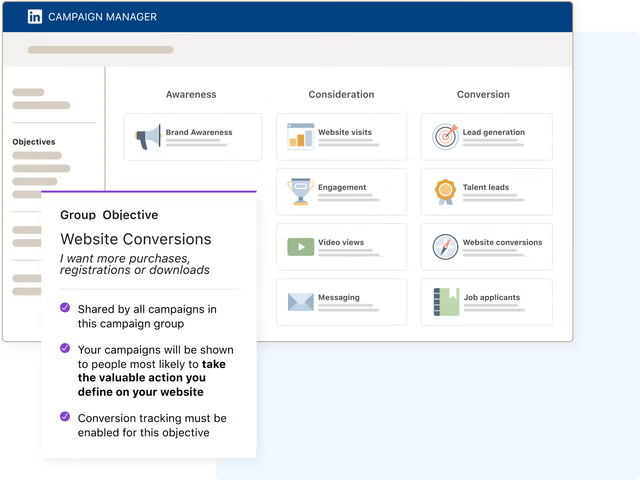
When LinkedIn Makes Sense
LinkedIn advertising makes sense when your average deal size exceeds $5,000, you’re targeting specific job titles at specific company sizes, you need decision makers not researchers, and your sales cycle spans 3-12 months. B2B customer journeys average 7 months from first touch to closed deal, and LinkedIn’s consistent presence across that timeline keeps you visible without burning audiences through aggressive remarketing. If your ICP is “VP of Operations at manufacturing companies 100-500 employees in Ontario,” LinkedIn delivers that precision. Facebook and Google can’t match it.
Your Deal Size Exceeds $5,000
LinkedIn economics work when individual customer lifetime value justifies $100-$300 cost per lead. If you’re selling $500 monthly SaaS subscriptions, LinkedIn’s CPL doesn’t work. You need volume at low acquisition cost. Stick with Google Search or Facebook.
If you’re selling $2,000+ monthly contracts or $25,000+ one-time implementations, LinkedIn becomes your primary channel. An IT services company with $30,000 average project value can profitably spend $500 per lead if 10% of leads turn into proposals and 20% of proposals close. That’s $5,000 CAC for $30,000 ACV, or 6x return.
Your ICP Is Hyper-Specific
LinkedIn’s targeting precision is unmatched. You can target “Directors of Marketing at SaaS companies 50-200 employees in British Columbia who changed jobs in past 90 days who are first-degree connections of your sales team.” Try building that audience on Facebook. You can’t.
LinkedIn Matched Audiences let you upload your CRM list, target website visitors, build lookalike audiences from your best customers, and layer on firmographic filters. Marketing agencies targeting VPs at tech companies waste zero budget on small business owners, individual contributors, or decision makers outside their service area.
This precision matters more as costs rise. When you’re paying $8-$12 per click, you can’t afford to waste 40% of budget on irrelevant clicks. Precise targeting means every dollar goes toward your actual ICP.
You Need Decision Makers, Not Researchers
Google captures people researching solutions. Facebook captures people scrolling feeds. LinkedIn captures people making decisions. When someone downloads your whitepaper on LinkedIn, there’s a 70% chance they have budget authority or influence purchasing decisions. When someone downloads the same asset from a Google Search ad, there’s a 30% chance they’re a decision maker and 70% chance they’re an intern doing research for their boss.
This difference shows up in your sales cycle length and close rate. LinkedIn leads typically advance through your pipeline 30-40% faster than Google or Facebook leads because they’re actual stakeholders, not information gatherers. Your sales team spends less time qualifying and more time closing.
Your Sales Cycle Is 3-12 Months
LinkedIn excels at staying visible throughout long B2B buying cycles without burning audiences. Average B2B customer journey tracked by Dreamdata spans 7 months from first impression to closed deal, involving an average of 6.8 stakeholders across multiple touchpoints.
Your Sponsored Content appears in feeds. Your retargeting ads follow prospects across the platform. Your Thought Leader Ads from your CEO or VP of Sales maintain personal connection. This consistent presence keeps you top of mind without the aggressive remarketing frequency that burns Facebook audiences after 30 days.
LinkedIn’s ad influence actually strengthens as deals get closer to close. Dreamdata’s 2026 data shows LinkedIn ads appear more frequently in the final 90 days before deal close than in earlier awareness phases, meaning the platform plays a critical role in deal acceleration, not just top-of-funnel awareness.
If your sales cycle is under 30 days and highly transactional, you don’t need this sustained presence. Google Search or Facebook drive faster conversions for short-cycle B2B.
When to Skip LinkedIn and Use Google or Facebook Instead
Skip LinkedIn if your average deal size is under $3,000, you’re selling to small business owners or solopreneurs, or your sales cycle is under 30 days requiring 100+ leads monthly. LinkedIn’s $100-$300 CPL doesn’t work mathematically for low-ticket offers. You need volume at low cost per lead. Google Search captures high-intent bottom-funnel traffic at $3-$8 CPC. Facebook reaches broader audiences at $1-$3 CPC. Both deliver higher lead volume at costs that work for smaller deal sizes.
Your Deal Size Is Under $3,000
If you’re selling $500 monthly SaaS subscriptions, $1,500 consulting packages, or $2,000 one-time projects, LinkedIn’s economics don’t work. At $150 CPL, you’d need 5% close rate just to break even on a $3,000 sale. That’s unrealistic for most B2B.
Stick with Google Search for bottom-funnel intent or Facebook for top-funnel awareness and remarketing. Both platforms scale to hundreds of leads monthly at costs that work for lower-ticket offers. We’ve seen similar challenges with clients trying to force expensive channels for wrong use cases, like running Display campaigns for local service businesses when Local Services Ads deliver better results.
You’re Selling to Small Business Owners or Solopreneurs
Small business owners spend more time on Facebook and Google than LinkedIn. Web design agencies targeting local restaurants, retail shops, and service businesses waste budget on LinkedIn where restaurant owners rarely log in to evaluate vendors.
Facebook local ads reach small business owners in their personal feeds. Google Local Services Ads appear when they search “web designer near me.” Both channels deliver relevant traffic at fraction of LinkedIn’s cost.
LinkedIn’s strength is corporate decision makers at mid-market and enterprise companies. If your ICP is solopreneurs or businesses under 10 employees, LinkedIn targeting doesn’t help. You’re paying premium for precision you don’t need.
You Need Immediate Volume for Short Sales Cycles
If your sales cycle is under 30 days and you need 100+ leads monthly to hit revenue targets, LinkedIn’s higher CPL and smaller addressable audience becomes a constraint. Even with perfect targeting, you might reach only 50-80 qualified leads monthly in a niche Canadian market.
Google Search and Facebook scale faster with larger addressable audiences. Search captures active demand when people type high-intent queries. Facebook reaches massive audiences with granular interest and behavior targeting.
LinkedIn works best for quality over quantity. If your business model requires high lead volume to sustain operations, prioritize Google and Facebook over LinkedIn. Use LinkedIn for retargeting warm audiences and account-based marketing to specific target accounts, not primary lead generation.
How to Make LinkedIn Work at $5 to $12 CPC
1. Always Use Lead Gen Forms, Never Landing Pages
Lead Gen Forms convert at 6-12% versus landing pages at 2-4%, cutting your CPL by 25-35% immediately. LinkedIn pre-fills forms with profile data (name, email, job title, company) removing friction. Users submit without leaving the platform. Switching from landing pages to Lead Gen Forms can drop CPL from $180 to $120 with identical targeting and creative.
Keep forms short. Three fields maximum: name, email, company. Don’t ask for phone, website, or additional qualification questions. LinkedIn’s profile data already tells you their job title, seniority, and company size. You can qualify leads after they enter your CRM.
2. Target Micro-Segments, Not Broad Audiences
Create separate campaigns for “VP of Marketing at SaaS companies 50-200 employees” versus “VP of Marketing at SaaS companies 200-500 employees.” These are different buyers with different pain points, budgets, and decision-making processes.
Narrow targeting increases relevance scores, lowers CPC, and improves conversion rates. Broad targeting like “Marketing Directors in Canada” wastes budget on irrelevant impressions and dilutes your message trying to speak to everyone.
Build 8-12 micro-segmented campaigns, each targeting 5,000-20,000 people maximum. Test different messaging for each segment. A VP at a 50-person company cares about different problems than a VP at a 500-person company.
3. Run Retargeting to Warm Audiences First
Retargeting CPCs average $3-$6, roughly half of cold prospecting’s $8-$12. LinkedIn Matched Audiences let you retarget website visitors, video viewers, Lead Gen Form openers, and people who engaged with your posts.
Allocate 60% of budget to retargeting audiences who’ve already shown interest: people who visited pricing pages, watched demo videos, or downloaded whitepapers. Cold prospecting typically runs at $10 CPC while retargeting runs at $5 CPC, creating a blended $6.50 CPC.
Build audience pools first. Run organic content, post videos, share case studies. Let warm audiences accumulate for 30 days. Then launch retargeting campaigns to people who’ve already expressed interest. These audiences convert at 2-3x the rate of cold traffic.
4. Test Thought Leader Ads for Higher Engagement
Thought Leader Ads average $5-$15 CPC, often lower than traditional Sponsored Content because they generate higher engagement. These ads promote posts from your CEO, VP of Sales, or subject matter experts rather than your company page.
B2B buyers trust people more than corporate brands. A post from your VP of Engineering explaining a technical problem carries more credibility than the same message from your company account. That credibility translates to engagement, and engagement builds retargeting audiences.
Identify 2-3 executives or thought leaders on your team with active LinkedIn presence. Have them post weekly about industry trends, customer problems, and solutions. Boost the highest-performing posts as Thought Leader Ads. Make sure their profile clearly shows your company and has creator mode enabled so users can follow them.
5. Set $1,000-$3,000 Monthly Minimums
Accounts spending under $1,000 monthly struggle to gather enough conversion data for LinkedIn’s algorithm to optimize. You need 50+ conversions monthly for the platform to learn patterns and improve delivery.
At $100 CPL, $1,000 monthly budget generates 10 leads. That’s not enough data for optimization. At $2,500 monthly, you get 25 leads, borderline sufficient. At $3,000-$5,000 monthly, you get 30-50 leads, enough for meaningful learning.
Budget constraints force manual bidding and limited audience testing. If you can’t commit $1,500 monthly for 90 days minimum, LinkedIn probably isn’t your channel yet. Save budget, start with Google or Facebook, and revisit LinkedIn when you can fund proper testing.
6. Measure Cost Per SQL, Not Cost Per Lead
Most companies make the mistake of optimizing for cost per lead. LinkedIn delivers expensive leads. If you optimize purely on CPL, you’ll kill campaigns that drive revenue.
Track cost per sales-qualified lead (SQL) and cost per closed customer instead. A campaign with $200 CPL that generates SQLs at 30% qualification rate delivers $667 per SQL. A campaign with $100 CPL that generates SQLs at 10% qualification rate delivers $1,000 per SQL. The expensive campaign performs better.
Set up proper conversion tracking in your CRM. Pass SQL and Closed Won data back to LinkedIn via API or manual uploads. Optimize campaigns based on SQLs and revenue, not raw lead volume. This is the same principle we apply when optimizing Google Ads campaigns for Canadian service businesses – revenue attribution matters more than vanity metrics.
The Bottom Line on LinkedIn for Canadian B2B
LinkedIn ads cost 3-5x more per click than Facebook and 1.5-3x more than Google for Canadian B2B advertisers. Those higher CPCs stop mattering when your leads convert at triple the rate and close faster because they’re decision makers in your ICP, not researchers filling your pipeline with unqualified contacts.
LinkedIn owns 41% of B2B ad budgets globally because it delivers 121% ROAS when campaigns are properly structured. Canadian SMBs with deal sizes above $5,000, specific ICPs, and 3-12 month sales cycles should test it.
Start with $1,500-$2,500 monthly for 90 days minimum. Use Lead Gen Forms exclusively. Target micro-segments with laser precision. Run retargeting before cold prospecting. Test Thought Leader Ads for higher engagement. Measure cost per SQL and cost per customer, not cost per lead.
If your sales team closes LinkedIn leads 30% faster and at 2x the rate of Google or Facebook leads, scale budget aggressively. LinkedIn becomes your primary channel. If not, LinkedIn isn’t your channel and that’s fine. Some businesses are better served by properly structured Performance Max campaigns or retail media networks for product businesses.
The mistake is writing off LinkedIn because of sticker shock on CPC without measuring what actually matters: revenue per dollar spent. A $12 click that turns into a $30,000 customer beats a $2 click that goes nowhere.
At Latin Launch, we help Canadian B2B companies determine if LinkedIn makes sense before wasting budget testing blind. We audit deal sizes, sales cycles, and customer acquisition costs. We build micro-segmented campaign structures targeting your exact ICP. We optimize Lead Gen Form copy for Canadian B2B buyers. We track closed revenue, not vanity metrics. We’ve managed over $8M in B2B advertising spend, and we know when LinkedIn works and when it doesn’t.
Ready to test LinkedIn the right way? Book a free 20-minute B2B strategy call. We’ll audit your business model, tell you honestly if LinkedIn works for your use case, and show you exactly how we’d structure campaigns to hit 100%+ ROAS within 90 days. No fluff, no generic advice, just specific recommendations based on your numbers.
Frequently Asked Questions
Q: How much should Canadian B2B SMBs budget for LinkedIn ads in 2026?
A: Minimum $1,500-$2,500 monthly for 90 days to gather enough conversion data for optimization. LinkedIn’s algorithm needs 50+ conversions monthly to learn patterns and improve delivery. Below $1,000 monthly, you’re forced into manual bidding with limited testing capability, wasting budget on inefficient campaigns. If you can’t commit $1,500 monthly for a full quarter, save your budget and start with Google Search or Facebook until you can properly fund LinkedIn testing. Underfunding LinkedIn campaigns guarantees failure.
Q: Are LinkedIn ads worth it for small B2B companies with limited budgets?
A: Only if average deal size exceeds $5,000 and you can commit $1,500+ monthly for 90 days. LinkedIn CPL averages $100-$300 for Canadian B2B. You need sufficient customer lifetime value to justify that acquisition cost, and enough budget to generate statistically significant data. Companies selling $500-$2,000 deals should use Google Search (higher intent, lower CPC) or Facebook (broader reach, volume pricing) instead. LinkedIn economics don’t work for low-ticket B2B. The math has to math.
Q: How does LinkedIn compare to Google Ads for B2B lead generation in Canada?
A: LinkedIn costs 1.5-3x more per click ($5-$12 vs $3-$8) but converts at 2-3x higher rates (2.5-3.5% vs 2-4%) for B2B. LinkedIn captures decision makers actively evaluating solutions. Google captures researchers, analysts, and interns gathering information for stakeholders. LinkedIn works for quality, account-based targeting, and sustained visibility across 3-12 month sales cycles. Google works for volume, bottom-funnel intent, and short sales cycles under 60 days. Most successful B2B strategies use both: Google for demand capture, LinkedIn for demand generation and remarketing.
Q: What’s a good cost per lead on LinkedIn for Canadian B2B in 2026?
A: Depends entirely on deal size, close rate, and customer lifetime value, not industry averages. Technology/SaaS sees $50-$150 CPL. Professional services hit $75-$200. Manufacturing runs $100-$250. Enterprise software exceeds $200. Calculate your maximum acceptable CPL backward from economics: if average deal is $20,000 with 20% close rate and 5% sales commission, you can spend up to $3,750 per customer (18.75% CAC). At 20% lead-to-customer rate, that’s $750 maximum CPL. Anything below $750 is profitable. Don’t compare yourself to industry benchmarks, compare to your unit economics.
Q: Should Canadian B2B companies use LinkedIn Lead Gen Forms or send traffic to landing pages?
A: Always use Lead Gen Forms for lead generation campaigns. Forms convert at 6-12% versus landing pages at 2-4%, cutting CPL by 25-35% and dramatically improving campaign ROI. LinkedIn pre-fills forms with profile data (name, email, job title, company), removing friction and keeping users on platform. The only time to use landing pages is for bottom-funnel campaigns driving to specific demo booking or free trial signup where you need users in your product immediately. For top and mid-funnel lead generation, Lead Gen Forms deliver superior performance at lower cost. This isn’t debatable, it’s proven across thousands of campaigns.
Q: How long does it take to see results from LinkedIn ads?
A: Expect 2-3 weeks for initial learning phase, 60-90 days for meaningful performance data. LinkedIn’s algorithm needs volume to optimize delivery. First 14 days are learning mode where the platform tests different audiences, placements, and times. Don’t evaluate performance or make major changes during this window. After 30 days, you’ll see directional performance. After 90 days with consistent budget, you’ll have statistical significance to make optimization decisions. B2B sales cycles averaging 7 months mean some leads generated in month 1 won’t close until month 8-9. Track leading indicators (CPL, SQL rate, opportunity value) while waiting for lagging indicators (closed revenue, ROAS).
Explore More Articles